Cybersecurity in 2026: Why Deepfakes Are Becoming a Business Problem, Not Just a Meme
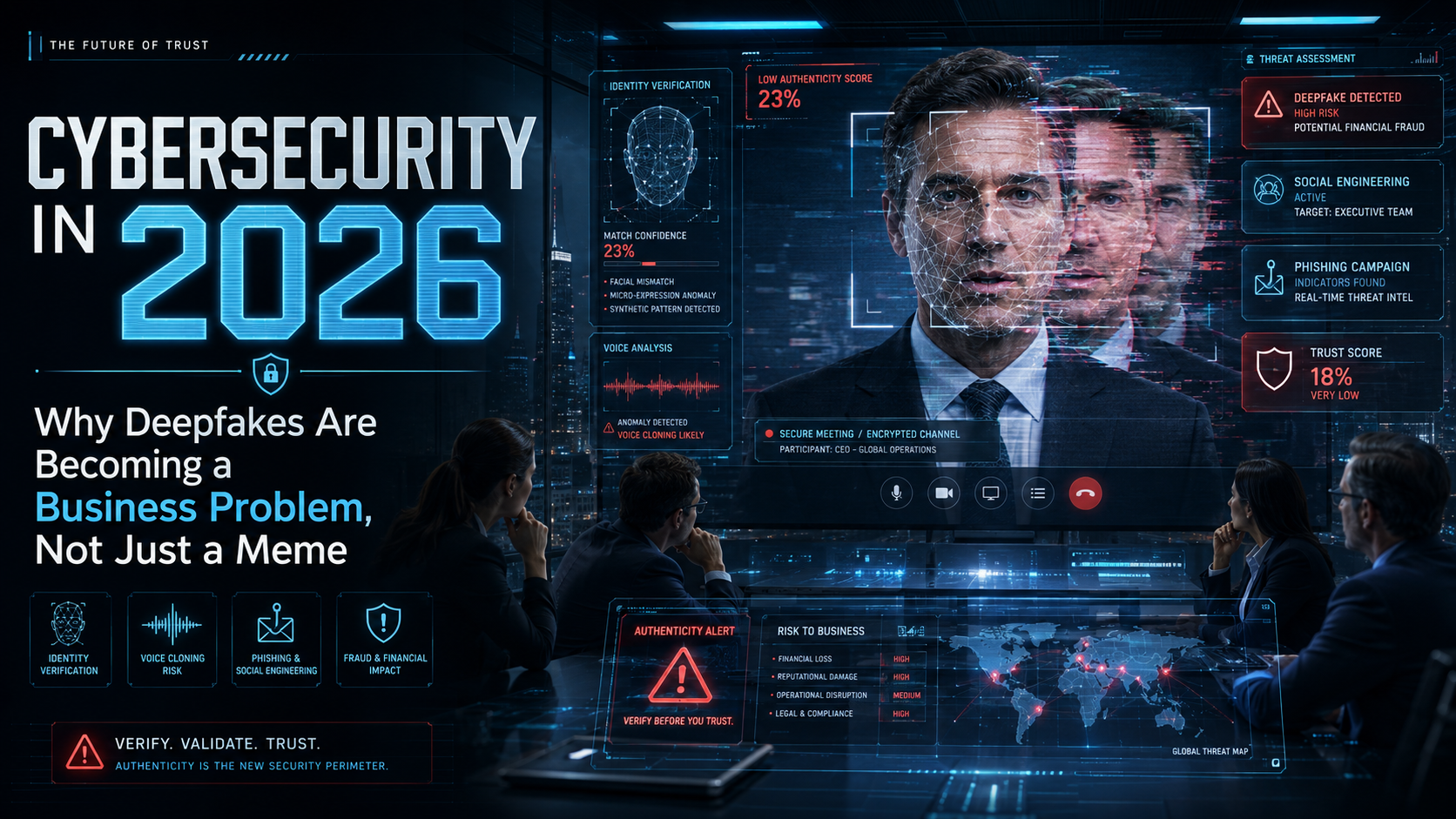
Cybersecurity in 2026: Why Deepfakes Are Becoming a Business Problem, Not Just a Meme
Deepfakes used to be a novelty — a funny video of a celebrity saying something they never said, a viral clip good for a laugh and not much else. That era is over. Deepfake technology has moved from entertainment into genuine business risk, and it's forcing cybersecurity teams to rethink assumptions that held for decades.
From Party Trick to Fraud Vector
The clearest sign of the shift is voice-cloning scams that impersonate executives to authorize fraudulent wire transfers — an employee receives what sounds exactly like their CEO's voice on a call, urgently instructing an emergency payment, and the voice is entirely synthetic. The same technology powers fake video calls used in social-engineering attacks, where a scammer doesn't just email a convincing message but appears on camera as someone they aren't. These aren't hypothetical scenarios; they're an active and growing category of financial fraud.
The Collapse of "Seeing Is Believing"
For most of human history, hearing a familiar voice or seeing a familiar face on a call was itself a form of verification — a reasonable basis for trust. Deepfake technology erodes that assumption directly. When synthetic audio and video can convincingly mimic a real person in real time, the old instinct to trust what you see and hear stops being a reliable security signal on its own.
A Human-Verification Problem, Not Just a Technical One
This shifts cybersecurity into territory that traditional tools weren't built for. Firewalls, passwords, and encryption protect data and systems, but they do nothing to stop someone from being convinced, in the moment, that they're talking to their boss. The practical response has been procedural rather than purely technical: out-of-band confirmation (verifying a request through a separate channel before acting on it), pre-agreed verification codewords for sensitive requests, and multi-person approval requirements for financial transfers, so no single convinced individual can authorize a major action alone.
AI-Generated Content Detection Becomes Its Own Field
In response, detecting AI-generated content is emerging as its own cybersecurity subfield — tools and techniques specifically built to flag synthetic audio, video, and images before they cause damage. It's an arms race by nature: as generation technology improves, detection has to keep pace, and neither side of that race is likely to declare permanent victory.
Why It Still Matters
The practical lesson for any organization is that verifying identity can no longer stop at "it sounded like them" or "it looked like them." As deepfake tools become cheaper and more convincing, the businesses least prepared are the ones still relying purely on that old instinct. The ones adapting are treating identity verification the way they'd treat any other security control — layered, procedural, and never dependent on a single point of trust.
SEO Keywords: deepfakes, cybersecurity, voice cloning, AI fraud, social engineering, business security, synthetic media, identity verification
Read next
The Rise of the Super App: Why One App Wants to Do Everything
WeChat proved one app can handle messaging, payments, and commerce at once — and Western and Gulf companies are chasing pieces of that same model.
Why Every Tech Company Suddenly Wants to Be a Chip Designer
From Apple's M-series to cloud providers' AI-training chips, custom silicon has gone from a rare specialist choice to a real competitive advantage.
The Streaming Wars Are Consolidating — What That Means for Your Subscriptions
After a decade of fragmentation, streaming is consolidating — mergers, password-sharing crackdowns, ads on premium tiers, and bundles echoing the old cable model.
Social Media's Next Shift: Why Short-Form Video Keeps Eating Every Platform
TikTok's format spread to Instagram, YouTube, and even LinkedIn — reshaping platforms that were never built around video in the first place.