The 10 Global Tech Trends That Will Define the Future
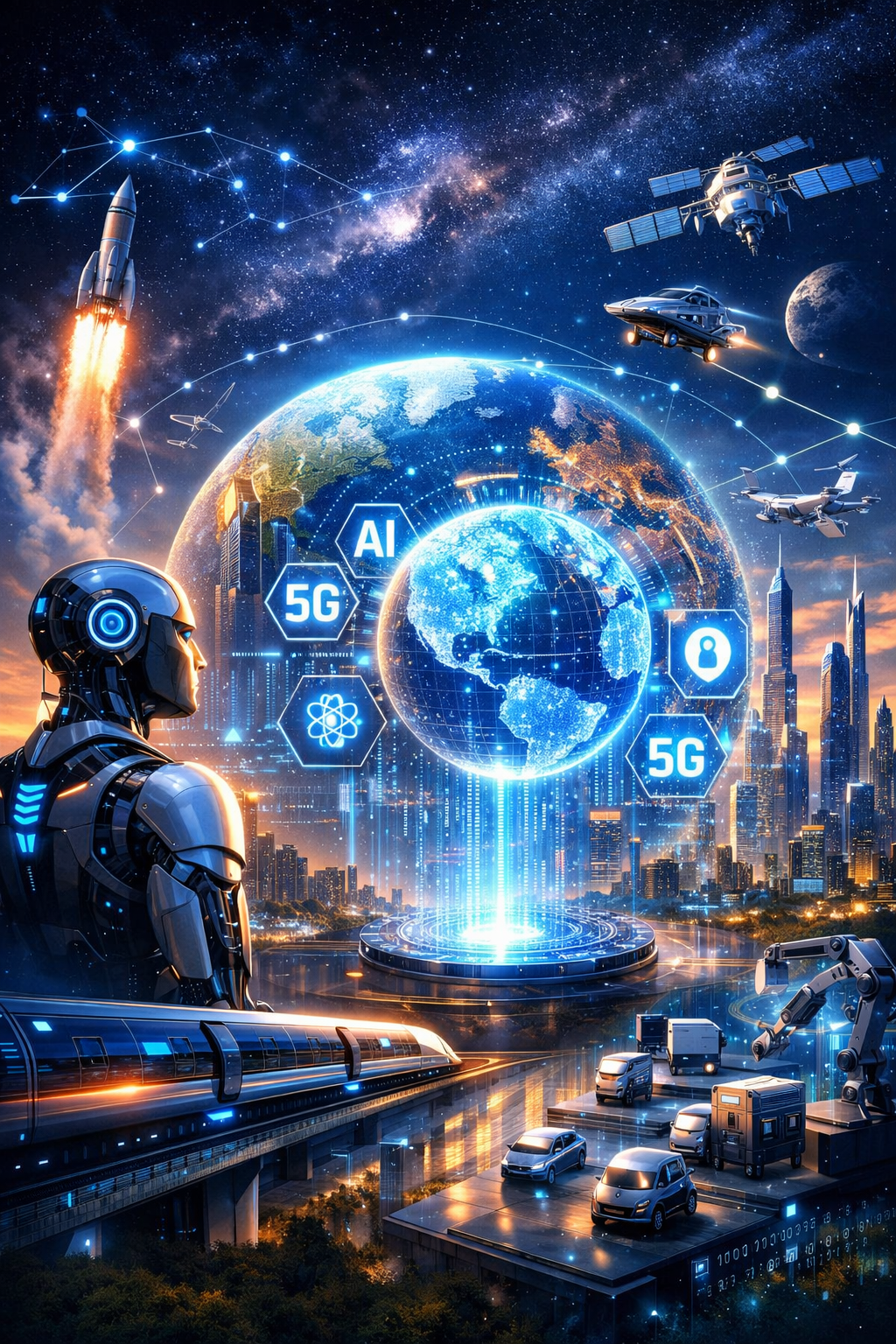
The 10 Global Tech Trends That Will Define the Future
- Hyper‑Automation: Self‑Running Companies Become Reality
AI, robotics, and autonomous systems are merging to create businesses that operate with minimal human involvement. From automated warehouses to AI‑managed finance departments, companies are shifting toward fully autonomous workflows. Impact: Operational costs drop by 40%, productivity skyrockets.
- AI CEOs and Algorithmic Leadership
Decision‑making is becoming data‑driven at the highest levels. AI systems can now analyze markets, predict outcomes, and optimize company strategies faster than human executives. Impact: AI handles up to 60% of strategic decisions.
- Digital Nations & AI Governance
Countries are building digital citizenship systems, AI‑managed public services, and virtual borders. Dubai, Estonia, and Singapore are leading the movement. Impact: Physical documents disappear; digital identity becomes universal.
4.Low‑orbit satellite networks are creating ultra‑fast global connectivity. This will eliminate internet dead zones and enable real‑time global communication. Impact: 100% global internet coverage by 2030.
- Quantum Cybersecurity
Quantum encryption will make traditional passwords obsolete. Banks, governments, and corporations are already preparing for quantum‑secure systems. Impact: Cyberattacks become significantly harder to execute.
- Human Enhancement Technologies
Biotech, wearables, implants, and genetic AI tools will enhance human capabilities. From memory‑boosting implants to AI‑powered prosthetics, human augmentation is becoming mainstream. Impact: Human performance increases beyond natural limits.
- Intelligent Megacities
Cities like Dubai, Seoul, and Singapore are evolving into fully autonomous ecosystems. AI will manage traffic, energy, policing, and public services. Impact: Urban efficiency increases by 70%.
- Autonomous Global Supply Chains
Robots, drones, and AI logistics will run global trade with near‑zero human labor. Shipping, warehousing, and delivery will be fully automated. Impact: Delivery times drop by 70%.
- The AI Freelance Workforce
AI agents will perform tasks traditionally done by freelancers — design, coding, marketing, editing. Platforms will host AI workers alongside humans. Impact: 30% of digital freelance work replaced by AI.
- Synthetic Reality & Digital Humans
Digital humans will host shows, run brands, and replace influencers. Synthetic reality will merge digital and physical worlds seamlessly. Impact: 50% of online personalities will be synthetic by 2035.
Conclusion 2026 is the turning point. The world is shifting from human‑driven systems to AI‑optimized ecosystems, from physical identity to digital citizenship, and from traditional industries to autonomous global networks. These trends will define the next decade — and the nations that adopt them fastest will lead the future.
Read next
Abu Dhabi Just Taught an AI to Understand Emirati — And It's Beating Models 19 Times Its Size
Abu Dhabi's Technology Innovation Institute has released Falcon-ASR, Falcon-Emirati, and Falcon-OCR-Arabic, a trio of AI models built specifically for Emirati dialect, not translated or approximated from Modern Standard Arabic. Early benchmark results suggest the UAE's bet on dialect-specific AI, rather than one-size-fits-all Arabic models, may be paying off.
The World's First AI Minister: How a 2017 UAE Appointment Became a Governance Blueprint
In 2017 the UAE created the world's first government ministry dedicated to artificial intelligence, backing it with a 2031 national strategy and a dedicated AI university. Nearly a decade on, other governments -- from Canada to Albania -- are only now experimenting with their own versions of the idea.