The Rise of Screenless Wearables: Why the Future of Health Tech Has No Display
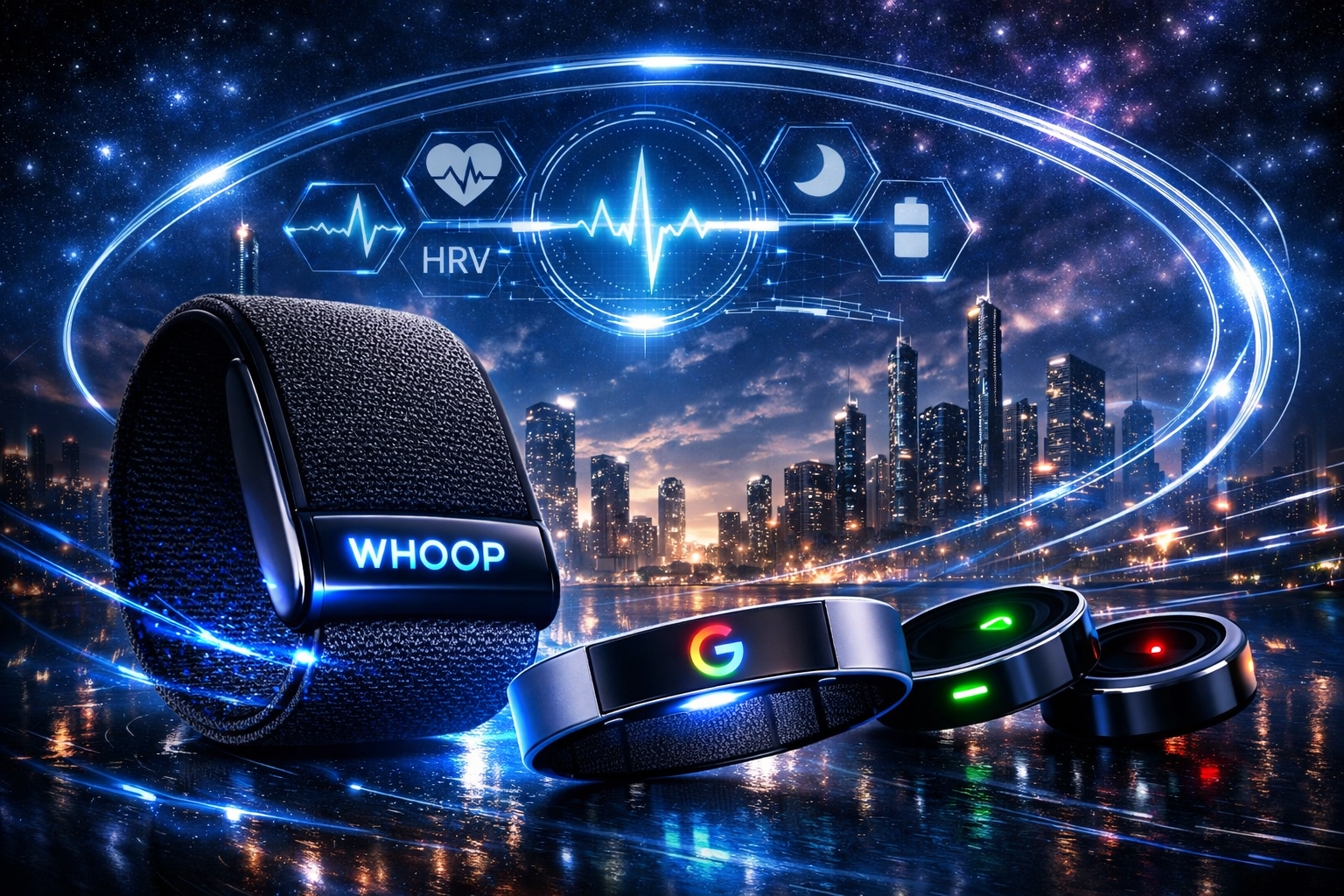
🔥 1. Why Screenless Wearables Are Exploding Worldwide The global boom of screenless wearables comes from three major shifts:
- People are tired of screens
Smartwatches became mini‑phones. Notifications, apps, distractions — all day, every day. Users wanted something quieter, simpler, and more focused. Screenless wearables deliver pure health data without interruptions.
- AI coaching is replacing visual interfaces
Modern wearables don’t need screens because: • AI explains your data • AI gives personalized coaching • AI tells you what to do next The interface is your phone — the intelligence is on your wrist.
- Recovery became more important than steps
The world finally realized: “How you recover matters more than how much you move.” WHOOP made recovery mainstream. Google and Garmin followed.
🟦 2. WHOOP — The Wearable That Started the Revolution WHOOP is the pioneer of screenless wearables. It focused on: • HRV • Recovery • Strain • Sleep • Stress load WHOOP became famous because elite athletes wore it: • LeBron James • Patrick Mahomes • UFC champions • Olympians • Formula 1 drivers WHOOP turned recovery into a global obsession — and created a new category of wearables.
🟦 3. Google Fitbit Air — The AI Wellness Band Google entered the screenless space with Fitbit Air, powered by Gemini AI. Fitbit Air focuses on: • Stress • Sleep • Daily readiness • Habit coaching • Android + Pixel integration It’s designed for everyday users who want intelligent health guidance without wearing a smartwatch. Fitbit Air made screenless wearables mainstream.
🟩 4. Garmin CIRQA — The Athlete’s Alternative to WHOOP Garmin launched CIRQA, a screenless band built for performance. It offers: • Sleep tracking • Recovery insights • Stress monitoring • 80+ workout modes • Optional subscription CIRQA is the closest competitor to WHOOP — but without mandatory membership. Garmin brought sports science into the screenless world.
🟧 5. Oura Ring — The Screenless Wearable for Longevity The Oura Ring isn’t worn on the wrist, but it’s one of the most influential screenless wearables. It tracks: • Sleep • HRV • Stress • Recovery • Women’s health Oura became huge in the longevity and biohacking community — CEOs, founders, and wellness influencers. It proved that screenless wearables can be fashionable.
🟪 6. Ultrahuman Ring Air — The Metabolic Health Powerhouse Ultrahuman is a rising competitor to Oura. It focuses on: • Metabolic health • Sleep • HRV • Recovery • Activity Ultrahuman is popular in India, UAE, and Europe — especially among fitness enthusiasts and biohackers. It shows how screenless wearables can be data‑rich without being visually loud.
🟫 7. WHOOP Body — The Future: Wearables Inside Clothing WHOOP took screenless wearables even further with WHOOP Body — sensors embedded inside: • Shirts • Shorts • Leggings • Sports bras This is the next evolution: Wearables that disappear completely.
⭐ 8. Why Screenless Wearables Are the Future Screenless wearables are booming because they deliver what modern users want: • Less distraction No notifications. No apps. No noise. • More intelligence AI coaching replaces screens. • Better accuracy Focused sensors outperform smartwatch multipurpose hardware. • Better comfort Lightweight, minimalist, and wearable 24/7. • Better recovery insights HRV, sleep cycles, strain, stress — the metrics that matter. Screenless wearables are not accessories. They’re health companions.
🏁 Final Thought The rise of screenless wearables marks a major shift in health technology. WHOOP pioneered it. Google and Garmin accelerated it. Oura and Ultrahuman expanded it. And WHOOP Body hints at a future where wearables disappear entirely. This is the new era of health tech — invisible, intelligent, and always on.
Read next
The Plug That Ate Its Rivals: How Tesla's Charging Port Became the Industry Standard
Tesla gave away its proprietary charging connector in 2022, and within three years nearly every major automaker had adopted it as SAE J3400. Here's how NACS won North America's charging wars — and why the Gulf, running on CCS2, never joined that fight.
Skype Is Gone: The Rise, Reign, and Quiet End of the App That Invented Video Calling
Microsoft pulled the plug on Skype in May 2025, 22 years after a band of Estonian engineers built the app that made free global video calling normal. Here's how it got bought twice, sidelined by its own owner, and why the UAE spent over a decade fighting its VoIP calling feature.